







What is Vertigo?
Vertigo is a condition where you feel like you’re spinning or unsteady. This can make everyday tasks like walking or standing difficult. It may last for a few minutes to hours.
Vertigo is not a disease in itself; it is a symptom of an underlying problem in the inner ear or the brain’s balance centers.
According to the cause, vertigo is primarily of two main types:
- Peripheral Vertigo: This is caused by a disorder of the inner ear. It accounts for nearly 80% of all vertigo cases and is usually more treatable.
- Central Vertigo: This happens when there’s a problem linked to the brain, often in the parts that help with balance and coordination of the body. Central vertigo is less common but more serious, and may be linked to conditions like stroke or multiple sclerosis.
Knowing what vertigo is and how to handle it is the key to the best way to manage it.
Why Does Vertigo Happen? (The Science Behind It)
Vertigo happens because of a communication breakdown between three systems your body uses for balance:
- The Inner Ear (Vestibular System) Detects head movement and gravity using fluid-filled canals and tiny calcium crystals called otoliths.
- The Eyes (Visual System) confirm what direction you are moving by what you see.
- The Brain (Central Processing) receives all signals and creates your sense of balance.
When these three systems send conflicting information, for example, your inner ear says you’re moving, but your eyes say you’re still, your brain gets confused. This confusion is experienced as vertigo.
The Most Common Inner-Ear Trigger
In BPPV (Benign Paroxysmal Positional Vertigo), tiny calcium carbonate crystals (called otoconia) get dislodged from their normal position and move into the semicircular canals of the inner ear. Every time your head moves, these crystals create false signals of rotation, triggering sudden vertigo.
Why Vertigo Happens More in Some People
- Age: The otoconia crystals become more fragile with age, making BPPV more common after 50.
- Head trauma: A blow to the head can dislodge inner-ear crystals.
- Prolonged bed rest: Staying still for long periods can cause crystal displacement.
- Hormonal changes: Women experience vertigo more frequently, possibly linked to estrogen fluctuations.
- Vitamin D deficiency: Research suggests low Vitamin D levels are associated with higher rates of BPPV recurrence.
What Happens During a Vertigo Attack?
Mixed Signals
Your inner ear helps you stay balanced like a built-in GPS system. But if something goes wrong in the ear (say, due to an infection or raised fluid pressure), it can send the wrong signals to your brain. Your ear might tell your brain that the head is moving, but your eyes don’t see any movement. This sensory mismatch causes the dizzy feeling.
Vertigo Symptoms: What You Feel
During a vertigo attack, you might experience:
- Spinning or Tilting: You feel like the room is moving or you’re losing balance.
- Nausea or Vomiting: You might feel sick to your stomach.
- Trouble Standing or Walking: It’s hard to stay steady, and you may require support to move around.
- Blurry Vision: Your eyes may have difficulty focusing, especially if there’s movement. This happens because the brain is receiving conflicting signals, causing involuntary eye movements called nystagmus.
- Sweating and Fast Heartbeat: Your body might feel anxious, causing you to sweat or feel your heart race.
- Ringing in the Ears or Hearing Problems: You might hear ringing in the ear or hearing loss if the problem involves both the auditory (hearing) and vestibular (balance) systems.
- Nystagmus (Involuntary Eye Movement): This is an important clinical sign that the eyes make rapid, uncontrolled movements during a vertigo attack, which doctors use to diagnose the type and cause of vertigo.
How Long Does It Last?
A vertigo attack can last anywhere from a few seconds to a few hours. The spinning usually stops faster if you remain still and avoid moving your head too much. BPPV attacks typically last under 1 minute, while Meniere’s disease attacks can last 20 minutes to several hours.
Vertigo Attack
A vertigo attack is a sudden episode of spinning or whirling sensation that may last from a few minutes to several hours. It often comes with nausea, imbalance, and difficulty focusing, making even simple activities unsafe.
The severity of an attack depends on its underlying cause:
| Cause | Typical Duration | Warning Signs |
| BPPV | Seconds to 1 minute | Triggered by head movement |
| Vestibular Neuritis | Hours to days | Sudden onset, no hearing loss |
| Meniere’s Disease | 20 min to several hours | Hearing changes, ear fullness |
| Vestibular Migraine | Minutes to 72 hours | Headache, light sensitivity |
| Central Vertigo (stroke) | Persistent | Suddenly, with neurological signs |
Step-by-Step Guide: What To Do During a Vertigo Attack
To remain safe and lessen discomfort, use these steps:
- Lie down or sit up straight away to avoid falls. Lower yourself slowly to the ground or nearest surface before you fall.
- Hold your head very still, and attempt to concentrate on something constant. A fixed point on the wall works well; this is called a “gaze fixation” technique.
- Close your eyes or keep your room dark in order to minimize visual movement. If closing your eyes worsens the spinning, keep them open and focus on one still point.
- Sip water to keep yourself hydrated.
- Do not move suddenly with your head or body until the spinning has faded.
- Seek emergency medical assistance or request help in case the attack is long-term or occurs with chest pain, slurred speech, weakness, or vision impairment. These signs may indicate a stroke. Call emergency services immediately.
(This content can be marked up with a HowTo schema for improved extractability in AI/SEO snippets.)
Structured Treatment Options
| Treatment | Purpose | Example |
| Medications | Reduce dizziness & nausea | Meclizine, Betahistine |
| Repositioning | Move displaced inner-ear crystals in case of BPPV | Epley maneuver |
| Vestibular Rehabilitation Therapy | Retrain the brain to improve balance | Vestibular rehab exercises |
| Lifestyle changes | Prevent recurrence | Hydration, posture care, yoga |
| Vestibular Evaluation | Diagnose the root cause accurately | Video Nystagmography |
| Virtual Reality Therapy | Accelerate vestibular recovery | Immersive balance training |
Quick Comparisons
Vertigo Attack vs Dizziness
Feeling lightheaded or unsteady is a loose term for dizziness. The term vertigo attack is used specifically to refer to a false sense of spinning or whirling.
Detailed Comparison:
| Feature | Dizziness | Vertigo |
| Sensation | Lightheadedness, unsteadiness | False sense of spinning/rotation |
| Cause | Low BP, dehydration, anxiety | Inner ear or brain disorder |
| Duration | Usually brief | Seconds to hours |
| Associated symptoms | Faintness, weakness | Nausea, nystagmus, hearing changes |
Vertigo Attack vs Panic Attack
Vertigo attack = body unsteadiness caused by ear or brain messages. Panic attack = an episode of anxiety with palpitations, sweating, and fear.
| Feature | Vertigo Attack | Panic Attack |
| Primary cause | Ear or brain signal mismatch | Anxiety/psychological trigger |
| Main sensation | Spinning, imbalance | Intense fear, palpitations |
| Eye movement | Abnormal (nystagmus possible) | Normal |
| Hearing changes | Possible | Rare |
Recovery Timeline
- Mild attacks: Duration of a few minutes to 12 hours. Single Epley maneuver resolves BPPV in up to 80% of cases.
- Meniere’s disease or vestibular neuritis: The attacks can range from several hours to days.
- Recurrent vertigo attacks: May last weeks or months, although they may respond to appropriate treatment and rehabilitation.
- Post-treatment recovery: Most patients undergoing vestibular rehabilitation show significant improvement within 4–6 weeks.
What Causes Vertigo?
There are a few different reasons why you might experience vertigo. Understanding why vertigo happens in each case helps doctors choose the most effective treatment. Here are some common causes:
- Meniere’s Disease: This affects the inner ear and causes episodes of vertigo, hearing loss, and ringing in the ears. It’s due to increased fluid pressure in the ear, usually affecting one side, though about 15% of cases impact both ears. If left untreated, it can lead to permanent hearing loss.
- Vestibular Neuritis: This happens when a viral infection inflames the vestibular nerve, which controls balance. It causes dizziness, blurry vision, and nausea.
- BPPV (Benign Paroxysmal Positional Vertigo): This occurs when tiny crystals in the ear shift to the wrong position, causing short bursts of dizziness, usually triggered by head movements. BPPV is the single most common cause of vertigo, accounting for approximately 20–30% of all vertigo diagnoses.
- Vestibular Migraine: This is a type of migraine that causes dizziness along with headaches, light sensitivity, and motion sickness. It affects about 10% of the population, mostly women.
- Labyrinthitis: This is an infection of the inner ear that causes dizziness, hearing loss, and tinnitus (ringing in the ears). The hearing loss is usually very severe.
- Perilymph Fistula: This happens when fluid from the inner ear leaks into the middle ear through a small tear. It can trigger vertigo during activities like coughing or lifting heavy weights.
- Mal de Debarquement Syndrome (MdDS): After a long boat or plane ride, some people feel like they are still swaying, even when they’re back on solid ground.
- Acoustic Neuroma: A non-cancerous tumor on the balance nerve can cause dizziness, hearing loss, and facial numbness.
- Multiple Sclerosis (MS): MS is a disease that damages the nerve covering and disrupts the signals to the brain, leading to vertigo, vision problems, and balance issues.
- Stroke or TIA (Transient Ischemic Attack): Sudden vertigo accompanied by weakness, facial drooping, or speech difficulty may signal a stroke, a medical emergency.
Why Understanding Vertigo Matters
Vertigo is more than just feeling dizzy; it can be disorienting and disruptive. Whether it’s a one-time thing or something that happens more often, understanding vertigo can help you manage it better. If you or someone you know is experiencing these symptoms, it’s important to seek medical help. With the right diagnosis, you can get the needed treatment and return to feeling steady.
Who Should and Should Not Attempt Home Management of Vertigo
Home Management Is Generally Safe If:
- You have previously diagnosed BPPV and know your triggers
- The episode is mild and passes within a few minutes
- There are no accompanying neurological symptoms
- Your doctor has already prescribed a home exercise plan
Do NOT Attempt Home Management Alone. Seek Immediate Medical Help If:
- Vertigo comes on suddenly and severely without warning
- You experience slurred speech, facial drooping, or arm weakness (stroke signs)
- You have double vision, difficulty swallowing, or loss of consciousness
- The vertigo does not resolve after 1 hour
- You have a fall or head injury during the episode
- This is your first-ever vertigo episode
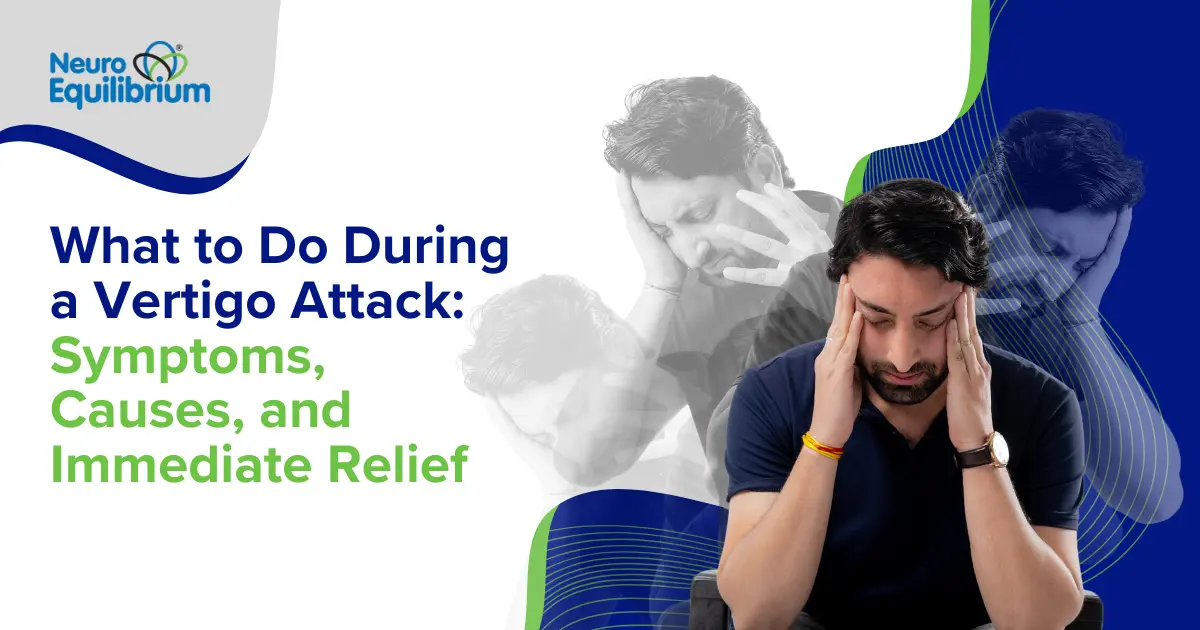
What to Do During a Vertigo Attack
Vertigo can make it feel like everything around you is spinning, which can be scary and difficult to deal with. However, there are steps you can take to feel better and stay safe.
Sit or Lie Down Right Away
When vertigo starts, sit or lie down somewhere safe so you don’t fall. Stay still and avoid trying to walk or move around until the spinning stops.
Focus on Something Still
Look at a steady object, like a picture or a piece of furniture. This can help your brain calm down and reduce the spinning sensation. This technique, called visual fixation, works because a stable visual reference helps override the conflicting signals from your inner ear.
Prevent Sudden Movements
Quickly moving your head or rising too swiftly can intensify dizziness. Instead, take slow and deliberate actions to maintain steadiness.
Stay in a Quiet, Dim Space
Bright lights or loud sounds can make vertigo feel worse. Go to a calm, quiet room with soft lighting, or close your eyes if you’re outside.
Drink Water
If you’re feeling sick or dizzy, dehydration can make it worse. Sip water slowly, but avoid sugary or caffeinated drinks since they can sometimes worsen vertigo symptoms. Caffeine and alcohol can trigger or worsen Meniere’s disease attacks specifically.
Take Deep Breaths
Vertigo can cause anxiety, which might make it feel even worse. Breathe deeply in through your nose and out through your mouth to stay calm. Controlled breathing (4 seconds in, 4 seconds hold, 6 seconds out) activates the parasympathetic nervous system and can reduce nausea.
Use Something for Support
If you need to move, hold onto a wall, railing, or sturdy furniture to help you balance. It’s also a good idea to tell someone nearby if you need help.
Avoid Driving or Operating Machines
During a vertigo episode, don’t drive or use heavy equipment because dizziness can make it unsafe. In India, patients with recurrent vertigo are advised to inform their treating doctor before driving.
These steps can help you manage the episode until it passes, or you can see a doctor.
When to Visit a Doctor
Sometimes vertigo needs medical attention, especially if:
- It lasts for more than a few hours.
- You have other symptoms like slurred speech, double vision, or weakness in your arms or legs.
- The dizziness keeps coming back or gets worse.
- You experience sudden, severe vertigo for the first time with no clear trigger.
- You notice gradual hearing loss or persistent ringing in one ear.
- Your vertigo is affecting your ability to work, drive, or perform daily tasks.
Specialized clinics such as NeuroEquilibrium use VNG, SVV, DVA and Caloric Testing to investigate recurring vertigo, depending on clinical findings, and treatments, including Video Nystagmography (VNG), posturography, and rotary chair testing for people with recurring vertigo.
Can Vertigo Be Cured?
Many people think their balance problems can’t be fixed, but that’s not true. Vertigo, a spinning or dizzy feeling, can be treated. With proper care, you can quickly return to living an everyday, healthy life.
Vertigo isn’t a disease; it’s a symptom. To treat it, specialists need to identify the underlying cause. Tests like VNG (Video Nystagmography) help determine what’s causing vertigo, so the treatment is accurate. In fact, BPPV, the most common cause, can often be resolved in a single clinic visit using the Epley maneuver.
Ways to Treat Vertigo
Vestibular Exercises
Specialised vestibular rehabilitation exercises can help improve balance, reduce dizziness and support visual stability during movement. For benign paroxysmal positional vertigo (BPPV), a trained specialist may perform canalith repositioning manoeuvres to guide displaced inner-ear crystals back into the correct position. Any home-based exercises should be recommended according to the patient’s diagnosis and performed under medical guidance.
Medications
In certain situations, medications can help ease the dizziness and nausea linked to vertigo. Vertin, Stugeron, or Stemetil may be prescribed for short-term symptom relief. However, using these medications for longer than five days can carry risks, so doctors generally recommend stopping them quickly. Long-term use of vestibular suppressants may actually slow down the brain’s ability to compensate and adapt, which is why medication alone is not the preferred long-term strategy.

Dietary and Lifestyle Changes That Help Prevent Vertigo
For many patients, especially those with Meniere’s disease or vestibular migraine, what you eat and how you live play a significant role in why vertigo happens and how often:
- Reduce salt intake to under 1,500 mg/day (helps manage Meniere’s by reducing endolymph pressure)
- Stay well-hydrated, aim for 8–10 glasses of water daily
- Avoid caffeine and alcohol, especially in Meniere’s disease
- Sleep 7–8 hours consistently; irregular sleep is a major vestibular migraine trigger
- Supplement Vitamin D if deficient. Studies link low Vitamin D to higher BPPV recurrence rates
- Avoid rapid head movements in the morning, when BPPV episodes are most common
- Managing stress, cortisol can worsen vestibular sensitivity
How to Prevent Vertigo
Taking care of your body and knowing your triggers can help reduce vertigo episodes:
Do Balance Exercises
Special physical therapy, called vestibular rehabilitation, helps your brain and inner ear work together to improve balance. Consistency matters; most patients benefit from daily 15–20 minute exercise sessions.
Learn Your Triggers
Certain movements or situations might cause vertigo for you. Keep track of these triggers and avoid them when you can. Keeping a vertigo diary, noting time, position, food, and stress levels before each episode, is a proven method for identifying personal triggers.
Schedule Regular Health Check-Ups
Occasionally, vertigo can be associated with other health concerns such as ear infections or blood pressure issues. Addressing these conditions early can help avert dizziness.
Follow Your Doctor’s Advice
If your doctor gives you medicine for vertigo or an underlying condition, take it as prescribed. This can help control your symptoms.
Conclusion
Vertigo can feel overwhelming, but understanding it and knowing what to do can make it easier to handle. In most cases, it goes away on its own, but if it doesn’t, seeing a doctor is important. With the right steps, like lifestyle changes, physical therapy, and regular check-ups, you can manage vertigo and get back to living without fear of spinning episodes.
At Neuroequilibrium, we leverage advanced technologies such as virtual reality to enhance vestibular therapy’s effectiveness. These treatments aim to accelerate patient recovery and promote prolonged well-being. Patients get a personalized treatment plan based on their symptoms and health problems. The therapy includes exercises to improve balance, reduce dizziness, and ease visual issues. Doctors also check progress regularly and change the treatment to relieve patients faster.
Frequently Asked Questions
What is the difference between vertigo and general dizziness?
Dizziness and vertigo are often confused, yet they are distinct sensations. Vertigo presents as a feeling of spinning or whirling, even when both the individual and their surroundings remain still. In contrast, dizziness is a broader term that encompasses feelings of faintness, lightheadedness, or balance issues that do not involve vertigo. Recognizing this difference is crucial for accurate diagnosis and effective treatment. While vertigo is linked to issues with the inner ear or brain, dizziness can stem from causes like dehydration, low blood sugar, or abrupt changes in posture. Being aware of these symptoms can help identify the underlying issue and facilitate appropriate care treatment.
Book a consultation at your nearest NeuroEquilibrium Clinic today.
What causes vertigo to occur suddenly?
Sudden vertigo can arise from various factors. Peripheral issues, like Benign Paroxysmal Positional Vertigo (BPPV), occur when small crystals in the inner ear become dislodged, resulting in dizziness during certain head movements. Infections such as vestibular neuritis or labyrinthitis can also cause sudden episodes. On the other hand, central factors may include strokes, migraines, or neurological disorders. Additional elements, like stress, dehydration, or quick changes in position, can worsen symptoms. It’s essential to determine the underlying cause through a medical assessment for effective treatment and prevention of future episodes, especially when vertigo occurs unexpectedly and disrupts daily life activities.
Book a consultation at your nearest NeuroEquilibrium Clinic today.
What should I do during a vertigo attack?
If you experience vertigo, it is best to stay seated and refrain from quick head movements that could aggravate the episode. For lightheadedness, find a seated or lying position to prevent fainting. When feeling dizzy, focus on a stationary object or fixate on a specific point. Avoid sudden movements, as they could exacerbate the sensation. Rest in a calm, dimly lit space to minimize sensory stimulation. If possible, hydrate with water to prevent dehydration, which could worsen dizziness. Most episodes resolve on their own; however, if symptoms persist for hours, intensify, or are accompanied by severe headaches, vision changes, or numbness, seek medical attention.
Book a consultation at your nearest NeuroEquilibrium Clinic today.
Can lifestyle changes help prevent vertigo?
Indeed, making lifestyle changes can lessen the occurrence and intensity of vertigo episodes. Participate in vestibular rehabilitation exercises to enhance balance and coordination. Be mindful of and steer clear of triggers you know, such as abrupt head movements or bright lights. Stay hydrated and eat a balanced diet, cutting down on excessive salt and caffeine if you have Meniere’s disease. Regular health check-ups can help identify and treat underlying issues like high blood pressure or ear infections. Additionally, employing stress management strategies, such as yoga or meditation, may aid in preventing vertigo associated with migraines or anxiety, allowing for better symptom control.
Book a consultation at your nearest NeuroEquilibrium Clinic today.
When should I seek medical attention for vertigo?
If your vertigo symptoms persist for several hours, frequently return, or worsen, seek medical assistance. It is also important to see a specialist doctor if vertigo occurs alongside severe headaches, slurred speech, vision problems, weakness, or issues with walking, as these may signal serious conditions such as a stroke or brain injury. For those with recurring symptoms, specialized clinics offer in-depth testing and personalized treatment plans. Prompt diagnosis and treatment can help identify the underlying cause of vertigo, lessen its effects on daily activities, and prevent possible complications.
Book a consultation at your nearest NeuroEquilibrium Clinic today.