
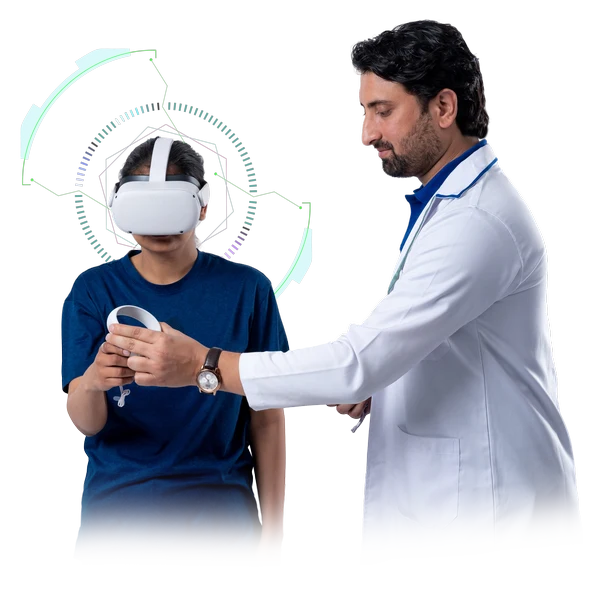


Advanced Balance Recovery with Immersive Technology
At NeuroEquilibrium, Virtual Reality Based Vestibular Rehabilitation Therapy (VRT) combines the proven science of vestibular rehabilitation with cutting-edge VR technology. The core principles of VRT remain the same: retraining the brain to restore balance, gaze stability, and motion control. What changes with VR is how effectively and engagingly these exercises are performed.
VR transforms conventional therapy into an immersive, data-driven experience which helps patients stay motivated, track progress in real time, and achieve faster recovery from dizziness, vertigo, and balance disorders.
VR technology enhances but does not replace the foundational vestibular assessment process. Accurate diagnosis continues to be the cornerstone of VRT success.
Through this hybrid approach, NeuroEquilibrium offers an evidence-based, technology-supported assessment pathway that ensures every patient receives a treatment plan aligned with their exact vestibular condition.
While the fundamental exercises of VRT like gaze stabilization, habituation, and balance training remain constant, Virtual Reality changes how these exercises are delivered and experienced.
VRT Core Principle | Traditional Approach | VR-Based Enhancement |
Engagement and Compliance | Exercises can become repetitive and difficult to maintain over time, reducing patient motivation and compliance. | VR makes therapy immersive and game-like, turning sessions into engaging challenges that patients look forward to. This keeps motivation and adherence high, directly improving outcomes. |
Real-World Simulation | Patients perform limited, controlled physical movements in clinic settings. | VR immerses patients in simulated real-world environments, such as walking across virtual uneven ground or balancing on a narrow beam, improving adaptability and spatial awareness. |
Habituation and Desensitization | Gradual exposure to dizziness triggers, such as head turns or moving patterns. | VR enables graded, controlled exposure to motion triggers (e.g., escalators, crowded streets, steep terrains), helping reduce motion sensitivity and anxiety in safe, repeatable virtual settings. |
Personalization | Exercises are adjusted manually based on observed progress. | VR systems automatically collect data and tailor programs in real time, providing a customized therapy experience that evolves as the patient improves. |
The result is a more interactive, personalized, and effective rehabilitation journey that helps patients regain confidence and independence faster.
The therapeutic goals of VRT remain centered on vestibular compensation, neuroplasticity, and improved functional stability.
However, VR-enhanced therapy accelerates these benefits through engagement, precision, and measurable feedback.
Most patients report improvement in dizziness, motion stability, and confidence within weeks, especially when VR-based sessions complement conventional vestibular therapy.
VR-based VRT is a safe, non-invasive, and clinically validated approach when administered under professional supervision.
At NeuroEquilibrium, all sessions are conducted or monitored by trained vestibular therapists who ensure exercises match each patient’s ability level and tolerance.
Patients are advised to consult their doctor before beginning therapy if they experience severe neurological symptoms such as sudden weakness, slurred speech, or loss of coordination, which may indicate underlying neurological conditions requiring urgent attention.
At NeuroEquilibrium, we combine clinical expertise with immersive technology to create a smarter, more personalized path to recovery from dizziness and balance disorders.
Book an Appointment Today..at one of our 200+ NeuroEquilibrium clinics across India and take the first step toward stable, confident movement.




NeuroEquilibrium VR-based VRT offers a comprehensive, engaging, and effective approach to vestibular rehabilitation, ensuring better outcomes for patients with vestibular disorders.
It is an advanced form of vestibular rehabilitation that combines traditional VRT exercises with immersive VR technology. Patients perform scientifically designed balance and gaze stabilization tasks within simulated environments that improve engagement, accuracy, and outcomes.
No. VR does not replace the principles of VRT it enhances them. The same foundational exercises are performed using advanced tools that improve precision, provide real-time feedback, and make therapy more motivating for patients.
VR creates controlled, realistic scenarios that challenge and retrain the vestibular system. By simulating movement and spatial environments, the brain learns to adapt more efficiently, reducing dizziness and improving stability.
Yes. VR therapy at NeuroEquilibrium is safe and supervised by qualified clinicians. Exercises are adapted to each patient’s tolerance, ensuring steady progress without excessive discomfort or fatigue.
While clinical supervision is essential during early stages, future VR systems aim to make at-home therapy possible through remote monitoring and cloud-based feedback, improving access and convenience for long-term care.



